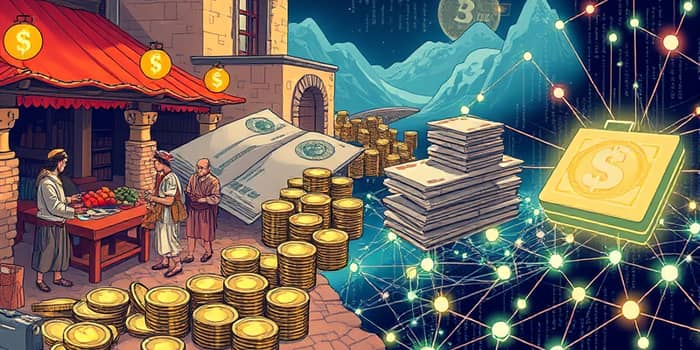
From the dawn of civilization to today’s cutting-edge financial technologies, the concept of money has undergone a breathtaking transformation. Understanding this journey empowers us to navigate the modern economy with confidence and vision.
Barter Systems: The Foundation of Trade
In Mesopotamia around 6000 BC, communities began swapping goods and services directly. This practice sparked specialization, leading to more complex societies.
However, two people had to want exactly what the other offered—a challenge known as the double coincidence of wants. Transporting bulky items across distances was also impractical, curbing trade’s potential.
Commodity Money: Standardizing Value
To overcome barter’s inefficiencies, cultures adopted items of common value as mediums of exchange. Cowrie shells, salt blocks, and livestock became widely accepted alternatives.
These items shared qualities such as durability, recognizability, and scarcity, paving the way for more reliable transactions.
- Acceptability across communities
- Portability compared to heavy goods
- Divisibility into smaller units
- Stable value backed by scarcity
Coined Metal Money: From Weights to Minted Coins
By the 7th century BC, Lydia in Anatolia struck the first metal coins. Gold and silver blanks were stamped with official designs, creating uniform pieces everyone trusted.
This innovation resolved valuation disputes, allowing merchants to conduct high-volume trade without constant weighing.
The advent of coins marked a fundamental building block of exchange that shaped economic empires.
Paper Money and Early Banking
Traveling with heavy coins posed risks in medieval China. To address this, merchants began issuing promissory notes in the Tang dynasty (618–907 AD).
By the Song dynasty (960–1279 AD), the government regulated paper certificates, establishing the world’s first state-backed currency. In Europe, merchant banks in the 12th century evolved similar banknotes, reducing banditry and boosting trade.
This era introduced the notion that credit could stand in for physical metal—a leap in financial innovation.
Fiat Currency and the Gold Standard Era
For centuries, paper money remained tied to gold reserves. Nations maintained trust by promising to redeem notes for metal on demand.
In the 20th century, most countries abandoned the gold standard, shifting to value based on legal consensus. This transition granted governments greater control over monetary policy, enabling economic stabilization during crises.
However, it also introduced risks of inflation and currency devaluation when mismanaged.
Digital and Electronic Money: The Internet Age
As computing advanced, banks digitized account records. Credit and debit cards, launched in the late 20th century, allowed instant payments without cash.
Online platforms like PayPal revolutionized cross-border transactions, offering instantaneous, global digital transactions at light speed compared to traditional clearing methods.
Electronic money democratized finance, granting individuals and small businesses more efficient ways to receive and send funds.
Blockchain and Cryptocurrencies: A New Frontier
In 2008, a pseudonymous developer released the Bitcoin whitepaper, describing decentralized, tamper-resistant shared ledger technology. This system records transactions in linked blocks validated by network consensus.
Unlike banks, the blockchain operates 24/7 without a central authority. Each transaction is time-stamped, immutable, and transparent to all participants.
- Sender initiates transfer from digital wallet
- Broadcast with a unique digital signature
- Nodes verify funds and prevent double-spending
- Transaction enters a block via mining or staking
- Consensus finalizes the block on the chain
- Recipient’s wallet updates instantly
These features deliver speed, security, and fairness unmatched by legacy systems.
- Cryptocurrencies: native digital assets for pure peer-to-peer transactions everywhere
- Stablecoins: fiat-pegged tokens for low-volatility remittances
- CBDCs: government-backed digital currencies for retail and wholesale use
Embracing the Future of Finance
As blockchain technology matures, programmable finance will automate agreements via smart contracts, enabling escrow, micropayments, and decentralized applications.
Forecasts predict the global blockchain market soaring past $1.43 trillion by 2030. Early adopters stand to benefit from increased efficiency, lower costs, and enhanced security.
Practical Steps for Individuals and Businesses
- Educate yourself on digital wallets and secure key management
- Diversify holdings: combine fiat, cryptocurrencies, and stablecoins
- Monitor regulatory developments in your region
- Experiment with small transactions to build confidence
By understanding money’s evolution—from humble barter exchanges to revolutionary blockchain networks—you can harness the strengths of each stage. Embrace innovation with caution and vision, and prepare your finances for tomorrow’s dynamic landscape.
References
- https://www.hiro.so/blog/tracing-the-social-narratives-shaping-the-future-of-money-bartering-to-banknotes-to-bitcoin
- https://stripe.com/resources/more/blockchain-payment-overview
- https://www.creditkarma.com/money/i/history-of-money
- https://www.thunes.com/insights/blockchain-cross-border-payments/
- https://crypto.com/us/university/history-of-money-barter-to-bitcoin
- https://bvnk.com/blog/blockchain-payments
- https://gsiassociates.com/exploring-the-evolution-of-money-from-barter-systems-to-digital-currencies/
- https://aws.amazon.com/what-is/blockchain/
- https://www.itrustcapital.com/learn/from-barter-to-bitcoin-the-evolution-of-money-throughout-history
- https://us.etrade.com/knowledge/library/cryptocurrency/what-is-blockchain-technology-beginners-guide
- https://www.youtube.com/watch?v=RGQCzVgmZrs
- https://freemanlaw.com/blockchain-technology-explained-what-is-blockchain-and-how-does-it-work-2/
- https://quant.network/perspectives/the-evolution-of-money-from-ancient-barter-to-programmable-finance/
- https://guides.loc.gov/fintech/21st-century/cryptocurrency-blockchain