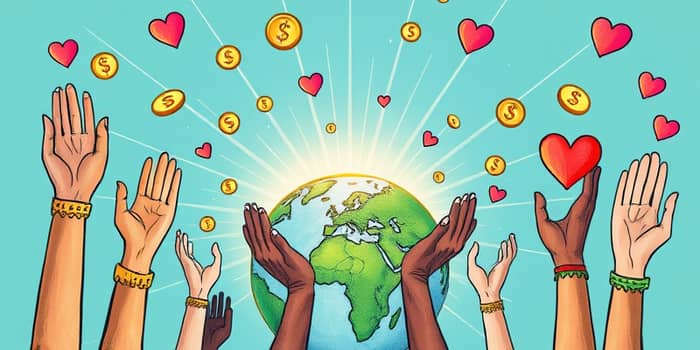
Philanthropy has emerged as a cornerstone of economic resilience and social progress in the early 21st century. In 2026, charitable giving not only addresses urgent needs but also contributes to broader economic stability. As individuals, corporations, and foundations deploy capital for public benefit, they generate a form of societal GDP that complements government and private sector efforts. This article examines the underlying economics of philanthropy, explores trends and incentives shaping giving, and offers practical strategies to maximize impact.
Scale and Economic Impact of Philanthropy
In recent years, the United States has seen record high corporate giving volumes with corporate contributions reaching $44.4 billion in 2024, up 9.1 percent year over year. Foundations also play a pivotal role, providing $109 billion in grants, which represent nearly one-fifth of all charitable giving. Donor-advised funds (DAFs) further amplify this ecosystem, channeling targeted support to nonprofits and communities in need.
When aggregated, these channels form a massive pool of social investment. Research shows that from 2020 to 2025, client philanthropy totaled $1.6 billion across 71,000 grants. Education, public benefit, and human services were the top recipients, reflecting donor priorities and societal gaps. By viewing these flows as a parallel economy, stakeholders can better assess the multiplier effects of grants and take a more data-driven approach to social returns.
Tax Policies and Incentives
Tax reforms in 2026 have reshaped philanthropic incentives. New corporate deduction limits restrict write-offs to no more than one percent of taxable income, prompting many companies to recalibrate their grantmaking strategies. At the same time, changes in non-itemizer rules have created awareness gaps among everyday donors, underscoring the need for clear communication from nonprofits and advisors.
With data-driven transparency measures in high demand, organizations are deploying financial dashboards and real-time reporting to demonstrate impact. These tools not only support donor trust but also encourage middle-income households to participate. By simplifying tax reporting and offering clear guidance on deductions, nonprofits can unlock new pools of generosity among those previously deterred by complex rules.
Donor Trends and Corporate Shifts
While total dollars continue to rise, philanthropy faces declining donor participation rates. Small donors have fallen, placing greater reliance on major and mega gifts. DAFs and private foundations have expanded as vehicles for sustained funding, offering strategic oversight and long-term capacity building.
Corporate philanthropy is also evolving. Employee engagement now drives many programs, with 57 percent of companies projecting growth in volunteer grants. Matching gift policies are becoming more generous, featuring higher ratios and lower minimums. To align with corporate priorities, nonprofits should tailor proposals to emphasize community impact and measurable outcomes.
- Food security initiatives (45% planned growth)
- Digital inclusion projects (41% planned growth)
- Housing affordability efforts (38% planned growth)
- Employee-driven giving initiatives
Global Dynamics and Effectiveness
Philanthropic outflows from 47 high-income countries totaled $70 billion in 2020, with overall resources reaching $841 billion when including official development assistance and remittances. Ninety-five percent of these funds originate in wealthy nations, with Africa and Asia as key destinations. In low- and middle-income countries, there is optimism about leveraging AI tools to optimize donations, even as some high-income donors express caution over automation.
Studies indicate that philanthropy often outperforms government and think tanks in fostering innovation, though it still trails NGOs and private sector institutions in operational efficiency. Public perception remains largely positive, with 63 to 84 percent of respondents across eight markets viewing high-net-worth donors favorably. However, skepticism persists around donor influence and agenda setting, calling for stringent accountability frameworks.
Challenges and Future Outlook
Despite its strengths, philanthropy confronts systemic challenges. Wealth inequality concentrates giving power, while political polarization can sideline support for sensitive causes such as racial justice or gender equality. Nonprofits must anticipate these headwinds by diversifying revenue sources and demonstrating strong governance.
Looking ahead, adaptive strategies like accountability, collaboration, and technology adoption will be critical. Embracing digital platforms for crowdfunding, incorporating AI for donor insights, and fostering regional partnerships can enhance resilience. By focusing on shared metrics and transparent impact assessment, the sector can navigate uncertainties in tax law, global politics, and economic cycles.
- Strengthen local and regional collaborations
- Implement clear outcome measurement systems
- Leverage digital fundraising and recurring gifts
- Maintain robust financial and programmatic transparency
Philanthropy stands at a pivotal moment. With the right mix of policy support, innovative vehicles, and community engagement, giving can continue to fill critical gaps, drive social innovation, and create lasting economic value. By uniting stakeholders around a shared vision of impact, we can build a more equitable and prosperous future for all.
References
- https://foundationsource.com/newsroom/media/2026-giving-outlook-adapting-to-reform-redefining-impact/
- https://globalindices.indianapolis.iu.edu/tracker/index.html
- https://www.nonprofitpro.com/article/companies-rethink-2026-philanthropy-priorities-amid-pressures-survey-says/
- https://capitalcampaignpro.com/capital-campaigns-2026-trends/
- https://doublethedonation.com/trends-in-corporate-philanthropy/
- https://philagiving.com/what-2026-philanthropy-trends-are-telling-us-and-what-theyre-missing/
- https://afpglobal.org/5-fundraising-trends-2026
- https://johnsoncenter.org/blog/11-trends-in-philanthropy-for-2026/
- https://www.philanthropy.com/solutions/5-trends-that-will-shape-fundraising-in-2026/
- https://www.ubs.com/global/en/sustainability-impact/our-insights/viewpoints/2026/trends-in-philanthropy.html
- https://orrgroup.com/trends-for-2026-whats-next-in-philanthropy-and-nonprofit-fundraising/