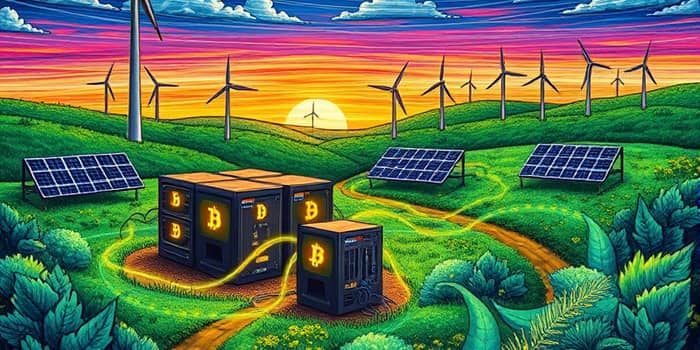
Cryptocurrency mining, especially Bitcoin, often faces harsh criticism for its environmental footprint, alleged inefficiency, and unsustainability. However, peeling back the headlines reveals a more nuanced reality—one where innovation, renewable integration, and grid stability reshape the narrative.
Common Myths vs. Reality
Before diving into data, let’s confront core misconceptions head-on. Many believe Bitcoin mining wrecks the planet, relies solely on fossil fuels, and wastes resources. In truth, miners increasingly optimize operations, harness stranded energy, and even bolster renewable grids.
- Excessive energy destruction: Bitcoin’s global energy use in 2020–2021 was 173 TWh—less than many industries and comparable to small nations.
- Fossil fuels dominance: While 67% of mining’s power came from fossil sources, the share has plummeted as renewables gain traction.
- Resource wastage: Advanced miners recycle heat for industrial use and pivot to low-impact sites.
Let’s explore the factual landscape and see why these myths no longer hold.
Quantifying the Environmental Footprint
Understanding scale is crucial. Between 2020 and 2021, Bitcoin mining consumed roughly 173 TWh of electricity—an amount that eclipses the annual power usage of some medium-sized countries. In the United States alone, the 34 largest mining facilities burned through 32.3 TWh in mid-2022 to mid-2023, surpassing the entire consumption of Los Angeles in a year.
Carbon emissions paint a similar picture. Mining generated an estimated 86 megatons of CO2 globally in 2020–2021—equivalent to burning 8.5 billion pounds of coal. U.S. operations contributed 27.4 million tons of excess CO2, three times what the largest American coal plant emits annually.
Water and land usage also raises concern. Miners worldwide used 1.65 cubic kilometers of water—filling 660,000 Olympic pools—and occupied 1,870 square kilometers of land, about 1.4 times the area of Los Angeles.
Top Mining Nations at a Glance
These ten countries account for 92–94% of global mining footprints, underscoring the need for targeted reforms.
Health Impacts and Air Pollution
Mining’s reliance on high-capacity power plants often harms air quality. In the U.S., 34 major mines added at least 0.1 μg/m³ of PM2.5 to the air for 1.9 million Americans. Regions near Texas mines saw spikes up to 0.5 μg/m³, and Metropolis, Illinois faced 13.1% of its PM2.5 from multi-state facilities.
Pollution doesn’t stay local. Wind patterns can carry contaminants hundreds of miles, meaning remote plants affect urban centers far away. Such externalities drive calls for cleaner alternatives—and miners are responding.
Debunking with Renewables and Efficiency
Contrary to assumptions, a growing portion of Bitcoin’s power comes from green sources. Estimates vary from 20% to over 70%, with industry groups like the Bitcoin Mining Council reporting a majority share. Miners actively seek stranded and underused energy—for instance:
- Nighttime surplus wind power on Texas’s ERCOT grid
- Flaring gas conversion at remote oil fields
- Solar peak output storage by mining rigs rather than batteries
These efforts yield grid-stabilizing benefits, as miners curtail operations during peak demand and ramp up when renewables overproduce. Partnerships in the UAE illustrate this: rigs shut down on scorching afternoons to free power for air conditioning, then resume at night.
Comparing with Traditional Industries
Context matters. Research by Ark Investment Management shows Bitcoin mining is more energy-efficient per dollar-value than gold extraction or global banking operations when considering office buildings, ATMs, and branches.
Even with its significant footprint, the digital currency network supports a decentralized financial system that operates continuously, contrasting with the heavy infrastructure behind conventional finance.
Innovation, Responsibility, and the Path Forward
Looking ahead, technology advances promise further gains. Next-generation ASICs, like the AS6, deliver higher hash rates with lower wattage. Creative solutions—such as using mining heat to smoke meats in rural facilities—turn waste into value.
Organizations like the Bitcoin Mining Council champion transparency and best practices. They publish quarterly sustainability surveys, tracking progress toward higher renewable shares and reduced carbon intensities.
Moreover, layer-two solutions like the Lightning Network decouple energy use from transaction volume, enhancing efficiency and lowering per-transfer costs.
Conclusion: A Balanced Perspective
Bitcoin mining undeniably carries environmental challenges, but the story isn’t black and white. Emerging data reveals a dynamic industry pivoting toward greener operations, unlocking stranded energy, and contributing to grid resilience. While critics rightly spotlight excess emissions and resource demands, proponents demonstrate that innovation and collaboration can forge a more sustainable future.
By understanding the nuances—embracing renewable energy integration, evaluating true carbon footprints, and supporting responsible mining initiatives—we can move beyond myths to foster a digital currency ecosystem that balances progress with planetary stewardship.
References
- https://www.youtube.com/watch?v=dasWYC1-7JM
- https://news.agu.org/press-release/bitcoin-mining-has-very-worrying-impacts-on-land-and-water-not-only-carbon/
- https://www.coinbase.com/learn/crypto-basics/7-biggest-bitcoin-myths
- https://unu.edu/press-release/un-study-reveals-hidden-environmental-impacts-bitcoin-carbon-not-only-harmful-product
- https://cash2bitcoin.com/blog/common-bitcoin-myths-debunked-what-you-need-to-know/
- https://hsph.harvard.edu/news/bitcoin-mining-increases-levels-of-air-pollution-harmful-to-human-health/
- https://www.bitstack-app.com/en/learn-bitcoin/8-bitcoin-myths-debunked
- https://pmc.ncbi.nlm.nih.gov/articles/PMC11537342/
- https://www.brookings.edu/articles/the-brutal-truth-about-bitcoin/
- https://earthjustice.org/feature/cryptocurrency-mining-environmental-impacts
- https://minebest.com/blog/debunking-blockchain-myths-part-1/
- https://www.imf.org/en/blogs/articles/2024/08/15/carbon-emissions-from-ai-and-crypto-are-surging-and-tax-policy-can-help
- https://www.financialplanningassociation.org/learning/publications/journal/MAR25-decoding-many-myths-bitcoin-open