Gross Domestic Product (GDP) has long been the flashlight guiding policymakers, businesses, and citizens through the complex corridors of national prosperity. Yet beyond its bright glow lie shadows of inequality, environmental damage, and overlooked human well-being. This article explores why GDP alone no longer suffices and how alternative metrics can illuminate a fuller, richer portrait of economic health.
By expanding our lens, we can craft policies that not only spur growth but also nurture communities, protect ecosystems, and foster genuine human development.
Shortcomings of GDP as a Measure
GDP’s simplicity has driven its global adoption, but its very design leaves critical dimensions unmeasured. It fundamentally ignores unpaid household production such as childcare and cooking, which sustains families and communities without entering market transactions.
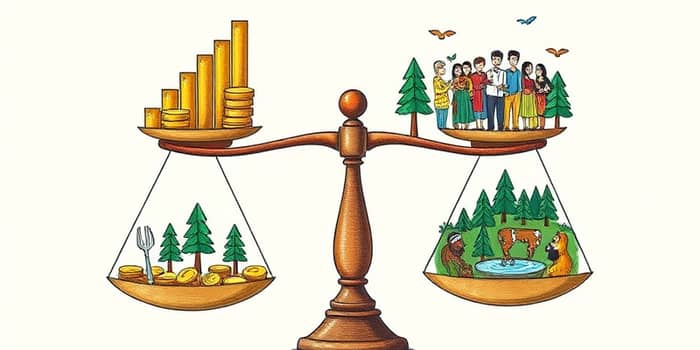
Moreover, GDP often counts negative activities as growth—from cleanup costs after natural disasters to expenditures related to crime—thus inflating figures even as they signal social harm. It also fails to account for future risks, like resource depletion, climate destabilization, and the loss of biodiversity.
- Unpaid work and household production excluded from calculations
- Income and regional inequalities masked by national aggregates
- Environmental degradation and social costs omitted
- Non-market exchanges—personal data for services—left out
- Long-term sustainability and resource constraints ignored
Consider that from 2001 to 2021 U.S. GDP rose by 45.4%, yet cities diverged dramatically: San Francisco’s economy expanded 87.4% while New Orleans contracted by 5.2%. Such discrepancies reveal GDP’s inability to reflect distributional effects.
Alternative Indicators: A Multifaceted Approach
To address these blind spots, scholars and institutions have developed complementary indicators that adjust GDP or bypass it altogether. These measures fall into two main groups: adjustments for social and environmental costs, and holistic well-being indices capturing non-monetary prosperity.
- Green GDP adjustments subtract pollution and resource depletion costs from traditional output values.
- Objective well-being indices integrate health, education, and income to assess human capabilities.
- Subjective surveys gauge life satisfaction, community vitality, and perceived quality of life.
Below is a condensed table summarizing some leading alternatives and their focus areas.
Each indicator offers a unique window: GPI reveals hidden social costs, HDI focuses on human capabilities, while the Ecological Footprint warns of overshooting planetary limits.
Implementing New Metrics in Policy
Governments and communities worldwide are piloting these metrics to design more inclusive policies. The European Union’s “Beyond GDP” initiative and the OECD’s Better Life Index provide frameworks for integrating multiple measures into policy evaluation.
At the national level, New Zealand’s Living Standards Framework employs natural, human, social, and financial capital measures to guide budget decisions. In the United States, cities like Burlington (VT) and states such as Vermont have adopted GPI reports to inform local development strategies.
- Customize metrics to local priorities and data availability
- Engage stakeholders—business, labor, community groups—for legitimacy
- Publish regular reports to spark public dialogue on true prosperity
- Link budget allocations to well-being targets and environmental safeguards
Businesses are also stepping forward: B Corporations and multi-stakeholder cooperatives embrace triple-bottom-line accounting, balancing profit with people and planet. Such models illustrate that responsible growth and community resilience can go hand in hand.
Looking Ahead: Towards Sustainable Well-Being
As the global economy continues to evolve, so must our measures of success. Relying solely on GDP is akin to navigating by a single star. By adopting a constellation of indicators—encompassing health, education, equity, and ecological stability—we gain a true north for sustainable prosperity.
Ultimately, thriving economies are not just engines of output but crucibles of human fulfillment and environmental stewardship. When policymakers, businesses, and citizens embrace broader metrics, we unlock pathways to societies that flourish equitably and endure for generations to come.
It is time to redefine progress, to look beyond mere numbers, and to cultivate economies where every individual and ecosystem can prosper together.
References
- https://sustainableconsumption.usdn.org/initiatives-list/alternative-economic-indicators
- https://www.lisep.org/content/gdp-poor-measure-of-nations-economic-health-says-ludwig-institute-report
- https://www.stlouisfed.org/open-vault/2023/apr/three-other-ways-to-measure-economic-health-beyond-gdp
- https://hhsievertsen.github.io/EconDataBook/limits-to-gdp-alternative-measures.html
- https://www.thebeyondlab.org/article/whats-next-on-beyond-gdp-2
- https://worth.com/gdp-gdp-limitations-economic-health/
- https://unu.edu/cpr/report/beyond-gdp-and-multidimensional-vulnerability-index
- https://corporatefinanceinstitute.com/resources/economics/gross-domestic-product-limitations/
- https://www.oecd.org/en/topics/policy-issues/well-being-and-beyond-gdp.html
- https://www.globalpolicyjournal.com/blog/05/08/2025/alternative-conceptual-framework-gdp-measuring-well-being-interview-james-k-boyce
- https://www.c40knowledgehub.org/s/article/Beyond-GDP-How-your-city-can-use-alternative-measures-of-social-environmental-and-economic-progress
- https://www.visionofhumanity.org/the-problem-with-gdp/
- https://joint-research-centre.ec.europa.eu/projects-and-activities/beyond-gdp-delivering-sustainable-and-inclusive-wellbeing_en
- https://www.imf.org/en/publications/fandd/issues/series/back-to-basics/gross-domestic-product-gdp