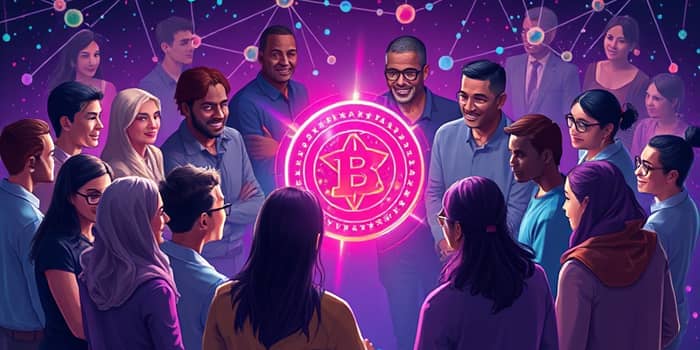
Governance tokens are redefining how communities collaborate, decide, and evolve in the world of decentralized finance and blockchain. By granting holders the power to vote on protocol upgrades, parameter changes, and treasury allocations, these tokens transform passive investors into active stewards of emerging digital ecosystems.
In this article, we explore the core concepts, mechanisms, real-world successes, and future potential of governance tokens. Our goal is to inspire and empower you to engage meaningfully in decentralized governance, ensuring your voice helps shape the projects you care about.
Empowering Communities Through On-Chain Decisions
At their essence, governance tokens provide voting rights over protocol changes without reliance on centralized authorities. Holders can propose upgrades, debate improvements, and approve or reject critical adjustments.
This model fosters community-led evolution of technology, as token holders collectively become {“protocol owners”}, steering development through open dialogue and transparent on-chain records. Decentralized Autonomous Organizations (DAOs) rely on these tokens to distribute power equitably, aligning incentives between users, developers, and investors.
Key Mechanisms Driving Decentralized Governance
Governance tokens operate through several interconnected systems that ensure fair and efficient decision-making:
- Token-based voting: Power scales with balance or delegated balance, allowing one token to equate to one vote.
- Delegation systems: Holders assign their votes to trusted delegates, improving participation without sacrificing representation.
- On-chain vs. off-chain voting: On-chain voting binds execution to smart contracts; off-chain tools like Snapshot allow informal signaling before ratification.
- Proposal thresholds and quorums: Minimum holdings to propose changes and required participation levels ensure legitimacy.
- Timelocks and safety mechanisms: Built-in delays prevent hasty changes and allow community review.
- Treasury management: Grants, investments, and tooling are funded through collective decisions on protocol reserves.
Real-World Success Stories
Several pioneering protocols illustrate how governance tokens empower stakeholders and drive innovation:
These examples show holders becoming active participants rather than passive investors. By shaping risk parameters or unlocking grant programs, communities can respond swiftly to market shifts and security challenges.
Unleashing Benefits Beyond Borders
Governance tokens bring a range of advantages that extend far beyond traditional corporate structures:
- Decentralization and alignment: Distributes power among stakeholders, ensuring developers remain accountable.
- Transparency and auditability: On-chain records provide immutable proof of each proposal and vote.
- Adaptability to change: Swift protocol adjustments in response to market dynamics.
- Community engagement: Encourages active participation, delegation guides, and educational resources.
- Fairness and equity: Proportional influence prevents single-entity dominance.
- Aligned incentives: Token-based rewards encourage long-term commitment to protocol health.
These benefits create ecosystems where users and developers share a unified vision, driving innovation through collective intelligence.
Navigating Risks and Building Resilience
Despite their promise, governance tokens face challenges that require careful design and community education:
- Centralization risks: Early protocol guardians or large holders can sway outcomes disproportionately.
- Low turnout: Voter apathy may limit legitimacy without effective delegation or engagement strategies.
- Security concerns: Timelocks and multisig controls are essential to guard against malicious proposals.
- Coordination overhead: Complex voting procedures call for clear templates and transparent reporting.
To overcome these hurdles, DAOs implement tiered quorums, educational campaigns, and public dashboards that encourage participation and maintain trust.
Charting the Path Forward
As governance tokens evolve, emerging designs blend on-chain execution with off-chain voting, hybrid delegation, and quadratic voting to enhance fairness and scalability. These innovations aim to:
Bridge the gap between token holders and active contributors by rewarding meaningful engagement over simple balance metrics.
Foster inclusive ecosystems where diverse voices shape the trajectory of decentralized applications and financial services.
Your involvement can make a real difference. By participating in governance discussions, proposing thoughtful improvements, or serving as a delegate, you help ensure protocols remain resilient, adaptable, and aligned with community values.
Together, we stand at the forefront of a new era—one where technology and community merge to create fair, transparent, and ever-evolving digital systems. Embrace your role in this journey, and let governance tokens be the catalyst that empowers you to shape the future of decentralized protocols.
References
- https://www.cube.exchange/what-is/governance-token
- https://mantrachain.io/resources/learn/what-are-governance-tokens
- https://www.dydx.xyz/crypto-learning/governance-token
- https://blog.colony.io/governance-token/
- https://www.ledger.com/academy/what-is-a-governance-token-and-why-does-it-matter
- https://www.binance.th/en/academy/essential/5ff536c0d5ff4e5ea7e55cbb260489fb
- https://www.moonpay.com/learn/defi/what-are-governance-tokens
- https://nonfungible.com/academy/nft/governance-tokens