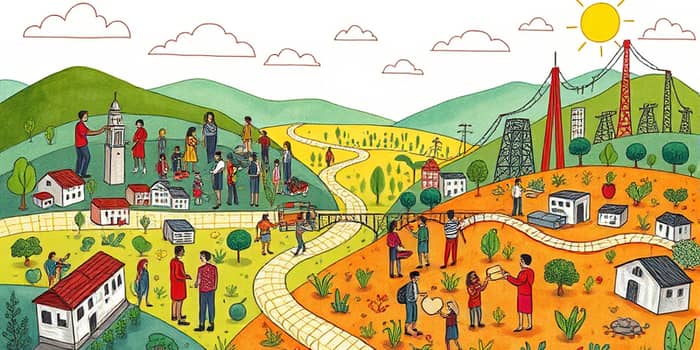
In an interconnected world, economies face a spectrum of shocks that test their strength and adaptability. From global pandemics to financial crises and natural disasters, the ability of a community to navigate upheaval and emerge stronger defines its long-term success and sustainability.
Economic resilience is not about invulnerability but about preparedness and transformation. It encompasses strategies that allow systems at every scale to absorb stress, adjust to new realities, and rebuild with enhanced capabilities.
Understanding Core Concepts
At its foundation, economic resilience refers to the capacity to absorb disturbances and adapt while maintaining essential functions. Experts distinguish between static and dynamic resilience, each offering a lens on performance during and after shocks.
Static resilience measures how well a system functions amid a disturbance, evaluating performance against worst-case outcomes. Dynamic resilience, by contrast, tracks the speed and efficiency of recovery, focusing on how quickly growth trends return to their pre-shock trajectory.
Types and Distinctions
- Macroeconomic resilience at national or regional scale
- Microeconomic resilience at household and individual levels
- Business-level resilience for firms and industries
- Regional versus national measures and indices
- Distinguishing resilience from vulnerability and risk
Macroeconomic resilience emphasizes fiscal balance, robust financial institutions, and currency stability to minimize consumption losses. Microeconomic resilience leverages social safety nets, such as unemployment benefits and healthcare, to support households directly.
Business resilience focuses on supply chain diversification, agile operations, and risk management frameworks that turn disruptions into innovation opportunities. Regional indices often integrate factors like industry diversity, infrastructure quality, and social cohesion to capture local strengths and weaknesses.
Key Indicators and Major Indices
Assessing resilience relies on a range of quantifiable metrics related to stability, governance, infrastructure, and social systems. Common indicators include:
- Macroeconomic stability measures (inflation, debt ratios, unemployment)
- Institutional quality and governance effectiveness
- Market efficiency and trade openness
- Social safety nets and community cohesion
- Infrastructure robustness and innovation capacity
Composite indices synthesize these metrics into comparative scores. The table below summarizes several leading resilience indices:
Strategies for Building Resilience
- Supply chain diversification and redundancy
- Investment in technology and workforce adaptability
- Strengthening financial systems and credit access
- Expanding social safety nets and healthcare
- Promoting innovation and continuous learning
By diversifying suppliers, encouraging local production, and maintaining strategic reserves, businesses can withstand disruptions. Governments enhance capacity through prudent fiscal policies, transparent institutions, and targeted social programs that protect vulnerable populations.
Real-World Examples and Insights
The COVID-19 pandemic illustrated the power of digital transformation and agile operations. Retailers with established e-commerce platforms pivoted swiftly, maintaining revenue streams and customer engagement even as physical stores shuttered.
During the 2008 financial crisis, nations with stringent banking regulations and robust safety nets experienced faster recoveries and less social hardship. This underscores the value of proactive regulation and support mechanisms in cushioning shocks.
Regional case studies offer further lessons. In rural Alaska, a consortium of native villages invested in renewable energy and workforce training, reducing reliance on imported fuels. In South Florida, a coordinated resilience plan prioritized hurricane preparedness and economic diversification, resulting in improved coastal defenses and the growth of sustainable tourism.
Policy Implications and Conclusion
Building economic resilience requires a holistic approach that integrates macroeconomic stability, social welfare, and private sector engagement. Policymakers can leverage resilience indices to pinpoint vulnerabilities, allocate resources effectively, and track progress over time.
Ultimately, resilient economies not only withstand shocks but also learn and evolve. By embracing adaptability, collaboration, and innovation, communities can transform crises into catalysts for sustainable growth and shared prosperity.
References
- https://pollution.sustainability-directory.com/term/economic-resilience-theory/
- https://onemoneyway.com/en/blog/economic-resilience/
- https://commons.case.edu/cgi/viewcontent.cgi?article=1010&context=joe
- https://sites.cardiff.ac.uk/building-resilient-economies/what-is-economic-resilience/
- https://gca.org/estimating-economic-resilience-to-climate-impacts-the-gross-resilience-product-grp/
- https://www.recovery.newgrowth.org/economic-resilience
- https://www.huduser.gov/archives/portal/periodicals/em/winter12/highlight2.html
- https://www.fourtheconomy.com/post/defining-resilience
- https://ceds.midshore.org/resilience