In a world where 96% of adults hold formal financial accounts, an estimated 1.3–1.4 billion remain excluded from mainstream banking. This article explores how digital currencies can bridge that gap and empower the unbanked.
Understanding the Unbanked Challenge
The unbanked are individuals who lack access to formal financial services, relying instead on costly cash transactions or informal lenders. Globally, 1.3-1.4 billion unbanked adults face daily vulnerabilities, from limited savings options to exposure to exploitation.
Demographic patterns reveal that 55% of the unbanked are women, 52% come from the poorest 40% of households, and 55% live in rural areas. Nearly 62% have only primary education, and 54% are unemployed or out of the labor force. These factors compound to create persistent exclusion.
Milestones in Financial Inclusion Growth
According to Global Findex 2025, four in five adults now have a formal account, up to 96% worldwide. Between 2014 and 2021, 1.1 billion adults gained accounts through information and communication technologies. Mobile money alone accounts for a 7% reduction in the unbanked rate in low-income countries.
High-income economies also saw dramatic declines: the United States dropped its unbanked rate from 20% to 4.2%, while the euro area fell by 45%. Yet, despite these advances, large segments in Asia, Africa, and Latin America remain disconnected.
Digital Currencies: A Catalyst for Inclusion
Central banks and regulators are rapidly exploring digital currencies as tools for inclusion. About 94% of central banks are investigating central bank digital currencies (CBDCs), driven by goals like government disbursements, retail payments, and programmable cross-border payments.
- Retail CBDCs can facilitate person-to-person and point-of-sale transactions with minimal infrastructure requirements.
- Stablecoins, backed by regulated institutions, are emerging as bridges for efficient cross-border remittances.
- Tokenization of assets is gaining momentum, creating new pathways for unbanked individuals to access credit and savings products.
In India, the digital rupee pilot enables citizens to receive government subsidies directly into digital wallets. Similarly, partnerships between banks and fintech firms are leveraging regulated stablecoins to lower remittance costs by up to 60%.
Innovative Mechanisms to Reach the Unbanked
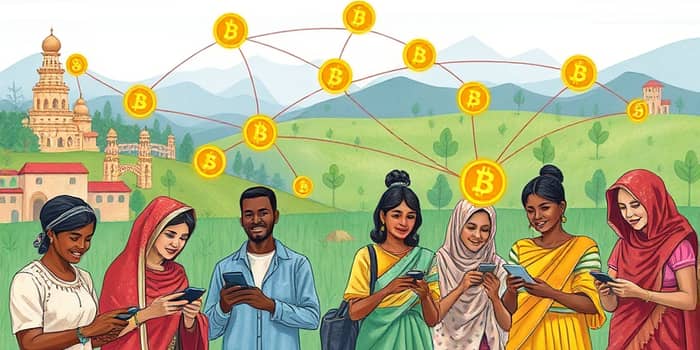
By combining digital wallets with robust onboarding, providers can bypass traditional barriers like brick-and-mortar branches. Mobile-based wallets reaching rural communities demonstrate how simple SMS or app interfaces can bring financial services to remote areas.
- 55% of existing bank customers now use mobile banking apps as their primary access point.
- 40% of the unbanked cite lack of technology access, yet 60% already own a mobile phone.
- Programs targeting youth financial literacy boosted account ownership by 15% among 18–25-year-olds.
Examples like M-Pesa in East Africa show how agent networks and mobile wallets can create inclusive ecosystems. In Southeast Asia, digital adoption among young adults rose 35% recently, underlining the potential for rapid scale.
Comparing Traditional and Digital Approaches
These comparisons highlight how digital currencies can overcome infrastructure gaps and lower costs, making them a strategic complement to traditional banking.
Overcoming Barriers to Access
Despite technological promise, challenges remain. Roughly 40% of the unbanked lack reliable internet or device access. Cultural norms deter 25% of women from opening accounts, and 30% of the unbanked have no primary education.
To address these barriers, stakeholders must invest in digital literacy, simplified identification processes, and community outreach. Embedding financial education within schools and local organizations can foster sustainable adoption and financial inclusion as a moral imperative.
Looking Ahead: Policy and Recommendations
Governments, multilateral agencies, and private investors are shifting toward hybrid funding and investment models that blend grants, impact investment, and AI-driven research. This new approach aims to sustain innovation beyond initial pilots.
Key policy recommendations include:
- Launching targeted CBDC pilots with strong consumer protections.
- Supporting regulated stablecoin frameworks to enable safe remittances.
- Investing in digital literacy and simplified on-boarding processes.
By 2030, universal access to formal financial services could lift one billion people out of poverty, underscoring the stakes of these reforms.
Conclusion: A Path to Shared Prosperity
Digital currencies offer more than payments innovation—they represent a chance to reshape global finance and unlock opportunity for the unbanked. Through collaboration among governments, financial institutions, and fintech innovators, we can build an ecosystem that values inclusion as much as profit.
By embracing these technologies and addressing barriers head-on, we move closer to a future where every individual can participate fully in the global economy, unlocking economic opportunities globally and fostering shared prosperity for all.
References
- https://www.centerforfinancialinclusion.org/financial-inclusion-in-2026-progress-funding-shifts-and-the-next-phase-of-the-sector/
- https://www.biia.com/financial-inclusion-at-record-high-but-1-3-billion-still-unbanked-world-bank-global-findex-2025-report/
- https://coinlaw.io/unbanked-population-statistics/
- https://www.jpmorgan.com/payments/payments-unbound/magazine/articles/financial-services-banking-unbanked
- https://www.itu.int/en/ITU-T/dfs/Pages/default.aspx
- https://digitalfinance.worldbank.org/home
- https://www.weforum.org/stories/2026/01/digital-economy-inflection-point-what-to-expect-for-digital-assets-in-2026/
- https://www.weforum.org/stories/2024/07/why-financial-inclusion-is-the-key-to-a-thriving-digital-economy/
- https://www.conference-board.org/research/CED-Newsletters-Alerts/the-outlook-for-digital-assets-in-2026
- https://www.fdic.gov/household-survey
- https://bulletin.bmeb-bi.org/cgi/viewcontent.cgi?article=2264&context=bmeb
- https://www.fintechfutures.com/bankingtech/the-global-unbanked-shoppers
- https://www.federalreserve.gov/econres/feds/initial-margin-for-crypto-currencies-risks-in-uncleared-markets.htm