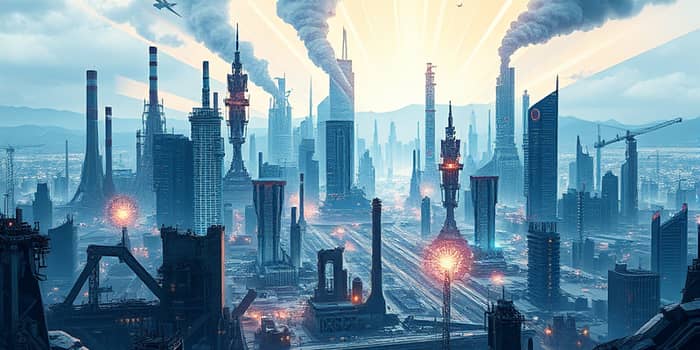
In a world where progress demands continual renewal, constantly changing economic structure drives firms and societies into cycles of upheaval and advancement.
This article explores how the concept of creative destruction reshapes industries, redistributes resources, and ultimately fosters long-term growth—despite the short-term pain it can inflict on workers, companies, and communities.
Origin of Creative Destruction
The term “creative destruction” was popularized by Austrian economist Joseph Schumpeter in his 1942 work Capitalism, Socialism and Democracy. Schumpeter built on Karl Marx’s insights into capitalism’s tendency to self-undermine and on earlier references by German sociologist Werner Sombart in 1913.
Schumpeter argued that capitalism thrives not in equilibrium but under the pressure of incessant innovation. Entrepreneurs, he wrote, unleash “the perennial gale of creative destruction,” where new methods of production or transportation replace outdated processes, propelling the economy forward.
Marx had described capitalism’s cyclical crises as clearing mechanisms, letting old modes of production collapse to enable new wealth creation. Schumpeter adapted this view, framing disruptive innovation as the driving engine of growth rather than mere collapse.
The Dynamics of Innovation and Market Forces
At its core, creative destruction emerges from entrepreneurial spirit and market competition. The profit motive pushes innovators to challenge incumbents by offering better goods, lower prices, or groundbreaking services.
Market forces act as an “invisible hand,” reallocating labor, capital, and raw materials from declining sectors to emerging opportunities. When producers fail to adapt, they risk obsolescence.
Through this process, resources move into more productive processes, ensuring that labor and capital deliver maximum value in evolving markets. Producers survive by streamlining operations and harnessing new tools that boost productivity.
The Paradox of Progress: Benefits vs. Costs
Creative destruction presents a paradox: societies cannot reap innovation’s rewards without enduring losses. Jobs vanish, firms fold, and regions rooted in legacy industries may face decline.
Yet over time, economies that embrace this process become more prosperous. Citizens enjoy shorter work weeks, enriched product offerings, and higher living standards. The willingness to accept disruption, Schumpeter contended, underpins sustained growth.
Criticisms and Challenges
Despite its virtues, creative destruction produces unequal outcomes for individuals. Some workers adapt and thrive, while others face prolonged unemployment and hardship.
Resource reallocation is not instantaneous. The theory of hysteresis warns that workers displaced by innovation may struggle to find new roles, leading to persistent unemployment above the natural rate.
Moreover, markets can overlook external benefits. The 1960s Beeching rail closures in the UK, aimed at cost-cutting, were later seen as shortsighted when railways’ contributions to reduced congestion and pollution became clear.
Contemporary critics also argue that the destructive element may now outpace the creative. Firms invest in rent-seeking strategies rather than genuine innovation, potentially stifling broad-based economic gains.
Policy Implications for Sustainable Growth
Governments face a dilemma: protect citizens from shock or allow markets to restructure. History shows that interventions to shield inefficient industries often backfire, dampening incentives for innovation.
- Invest in education and retraining programs to equip workers for emerging sectors.
- Implement targeted social safety nets to cushion the transition without stifling competition.
- Foster research and development through public–private partnerships and grants.
- Encourage geographic mobility by improving infrastructure and relocation support.
- Promote regulatory frameworks that reward experimentation and risk-taking.
By balancing short-term protections with long-term flexibility, policymakers can harness the benefits of creative destruction while mitigating its harshest impacts.
Real-World Examples Demonstrating Creative Destruction
The newspaper industry’s digital transformation illustrates the phenomenon. Print circulation plummeted as online platforms offered instant news, multimedia content, and user interaction. Legacy publishers either adapted with digital subscriptions or vanished.
Similarly, the rise of ride-hailing apps disrupted traditional taxi services worldwide. Drivers and companies that integrated digital dispatch, dynamic pricing, and customer feedback features survived; those that resisted change lost market share.
In manufacturing, automotive giants now pivot toward electric vehicles and autonomous systems. Legacy combustion-engine plants face closure unless repurposed for the new paradigm.
Looking Ahead: The Future of Innovation’s Gale
Emerging technologies—AI, biotechnology, quantum computing—promise fresh waves of creative destruction. Entire industries may be redefined or displaced by breakthroughs in automation, precision medicine, and materials science.
However, the social contract must evolve. Work patterns, education systems, and welfare policies require redesigning to prepare societies for faster, deeper transformations.
If managed wisely, creative destruction can drive unprecedented prosperity. If ignored, it risks deepening inequalities and social unrest. The choice rests on collective will to embrace change while caring for those swept aside.
Ultimately, innovation emerges from disruption, and the challenge of our era is to steer creative destruction toward inclusive and sustainable growth. By understanding its forces, we can craft policies and practices that turn upheaval into opportunity, ensuring that progress uplifts rather than abandons communities.
References
- https://www.economicshelp.org/blog/20255/economics/creative-destruction/
- https://en.wikipedia.org/wiki/Creative_destruction
- https://digitalleadership.com/blog/creative-destruction/
- https://www.econlib.org/library/Enc/CreativeDestruction.html
- https://learn.academy4sc.org/video/schumpeters-creative-destruction-die-to-live/
- https://www.youtube.com/watch?v=l-soJGRgAAQ