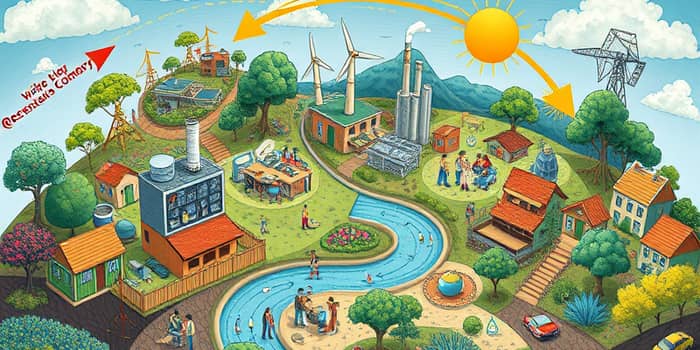
We stand at a crossroads where traditional consumption patterns threaten our planet’s stability and our communities’ well-being. The shift towards a circular economy offers a path to restore and regenerate natural systems while fostering economic innovation. By rethinking the linear “take-make-dispose” model, we can design a future where waste is eliminated, resources circulate at their highest value, and nature thrives once more.
This article explores the principles, benefits, real-world applications, and practical steps you can take to become part of this transformative movement. Join us on a journey to reshape how we produce, consume, and regenerate.
Understanding the Circular Revolution
Unlike the linear economy, the circular model is inherently restorative. At its heart lie three guiding principles defined by the Ellen MacArthur Foundation. Each principle invites us to rethink how products and materials flow through our economy.
- Eliminate waste and pollution from the design stage
- Circulate products and materials at their highest value
- Regenerate natural ecosystems and biodiversity through thoughtful practices
These core ideas extend into broader frameworks. The familiar “3Rs”—Reduce, Reuse, Recycle—form the foundation of many initiatives. A more comprehensive approach, the “9Rs,” invites us to Refuse, Rethink, Reduce, Reuse, Repair, Refurbish, Remanufacture, Repurpose, Recycle, and Recover. Together, they represent a closing of loops across systems.
Environmental and Economic Transformations
Implementing circular economy strategies can have seismic impacts on our planet. By designing out waste, we could halve global CO₂ emissions by 2030 relative to 2018 levels. This shift slows resource extraction, curbs pollution, and conserves biodiversity. In regions like the EU, increased recycling efforts have demonstrated tangible progress, yet the journey has only just begun.
On the economic front, the circular economy is a wellspring of opportunity. Estimates forecast a global market value of $888 billion by 2030 and potential economic growth of $4.5 trillion. Companies that embrace circular models report unlocking trillion-dollar economic growth through material savings, reduced energy use, and enhanced resilience against supply chain shocks.
Real-World Applications and Success Stories
From fashion to electronics to construction, circular practices are reshaping industries. Innovative brands lease and refurbish clothing, technology firms establish remanufacturing lines, and builders design modular structures that can be disassembled and reused. Each success story affirms that sustainability and profitability can go hand in hand.
- Fashion: Clothing rental platforms and fabric recycling programs.
- Electronics: Modular devices designed for easy repair and upgrades.
- Built Environment: “Make-use-return” building modules reducing waste.
- Food Systems: Composting programs transforming organic waste into fertile soil.
These efforts rely on design products for continuous reuse, collaborative value chains, and a commitment to decoupling economic activity from resources. They demonstrate that circular approaches can reduce costs, create jobs, and foster innovation across sectors.
Overcoming Barriers and Paving the Way Forward
Despite its promise, the circular economy faces obstacles. Deeply ingrained linear habits, regulatory gaps, and insufficient infrastructure can stall progress. Electronic waste, for instance, is surging by 2.6 million tons annually, highlighting the urgency for scalable repair and recycling solutions.
Yet every challenge creates an opportunity to innovate. By collaborating across governments, businesses, and communities, we can build the systems needed to transform consumption habits and material flows.
- Advocate for stronger policies that mandate recycled content and extended producer responsibility.
- Support community repair workshops and circular startup ventures.
- Choose durable, repairable products and participate in sharing platforms.
- Invest in renewable energy and regenerative agriculture to close material and biological loops.
By taking these steps, individuals and organizations alike become agents of change, driving the system toward building resilient and adaptive systems that benefit people and planet.
Join the Movement: From Insight to Action
The circular economy is more than a concept—it’s a call to action. Each decision we make as consumers, designers, and policymakers shapes the future we inherit. When we prioritize longevity, adaptability, and regeneration, we create ripple effects that strengthen communities, safeguard ecosystems, and secure prosperity for generations to come.
Embrace this transformative journey by reimagining how you live, work, and innovate. Together, we can be the architects of a regenerative world—one where waste is a relic of the past and resourcefulness paves the way for a thriving, equitable future. Embracing innovation for lasting impact starts with small choices today, but the dividends will echo for centuries.
References
- https://www.interlakemecalux.com/blog/circular-economy
- https://il.boell.org/en/2024/03/09/understanding-circular-economy-principles-benefits-and-applications
- https://www.oecd.org/en/topics/sub-issues/circular-economy-in-cities-and-regions.html
- https://youmatter.world/en/definition/definitions-circular-economy-meaning-definition-benefits-barriers/
- https://www.researchandmarkets.com/reports/6072064/circular-economy-market-report
- https://www.europarl.europa.eu/topics/en/article/20151201STO05603/circular-economy-definition-importance-and-benefits
- https://www.statista.com/statistics/1337519/circular-economy-market-revenue/
- https://www.ellenmacarthurfoundation.org/topics/circular-economy-introduction/overview
- https://www.circle-economy.com/cgr
- https://www.milliken.com/en-us/blogs/circular-economy-sustainability
- https://www.wri.org/insights/circular-economy-global-progress
- https://greenly.earth/en-us/blog/company-guide/circular-economy-definition-and-principles
- https://www.weforum.org/stories/2025/09/circular-economy-built-environment-future/
- https://www.unepfi.org/pollution-and-circular-economy/circular-economy/