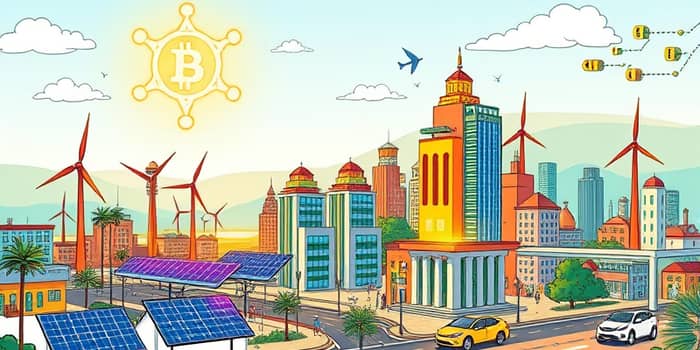
Across the globe, the fusion of blockchain technology and digital currencies is reshaping urban landscapes. Cities are evolving into dynamic, sustainable hubs that leverage innovative infrastructure to empower citizens and streamline services.
This article explores how urban centers deploy blockchain for transparent and efficient governance, peer-to-peer energy trading, and economic empowerment through local tokens. By delving into case studies, architectures, benefits, challenges, and future visions, we offer actionable insights for policymakers, entrepreneurs, and community leaders.
Real-World Implementations Across the Globe
Several pioneering cities demonstrate the transformative power of blockchain integration. From financial services and energy to waste management and mobility, these initiatives serve as blueprints for sustainable urban development.
- Dubai, UAE: Since 2016, Dubai has pursued a citywide blockchain strategy. Key projects include a secure electric vehicle charging network powered by blockchain and real-time energy data sharing aligned with its Green Mobility Strategy.
- Helsinki, Finland: In 2022, the city launched blockchain platforms for waste traceability and circular economy incentives, boosting recycling rates and citizen participation in sustainability programs.
- Los Angeles, USA: With a 9 million dollar state grant, LA deployed a blockchain enabled virtual power plant and microgrid hubs to support disadvantaged neighborhoods, advancing its carbon neutrality goal by 2050.
- Próspera, Honduras: This experimental special economic zone uses Bitcoin as legal tender and explores DAO governance models, attracting high-tech startups to its private urban community.
- Bitcoin City, El Salvador: Still in planning, this ambitious project envisions a crypto driven metropolis powered by geothermal energy, illustrating both the promise and volatility of digital currency economies.
Additional pilots span Singapore’s traffic optimization systems, Amsterdam’s sensor driven smart lighting, India’s land registry on blockchain, and US experiments in mobile voting and homelessness record keeping. Each initiative highlights unique local priorities while sharing a common thread of decentralized transparency and trust.
Key Applications in Urban Infrastructure
Blockchain and digital currencies offer versatile tools for modern cities. Their applications extend far beyond payments, unlocking new models for city services and citizen engagement.
- Energy and Sustainability: Peer to peer energy trading platforms enable residents to buy and sell surplus solar power. Smart grids integrated with blockchain automate billing and storage management.
- Governance and Public Services: Tamper proof voting systems, secure land records, and transparent permit issuance reduce fraud and increase public trust in municipal processes.
- Finance and Community Funding: Local cryptocurrencies and DeFi protocols finance infrastructure projects. Autonomous community ecosystems (ACEs) run by DAOs coordinate neighborhood greening, transit improvements, and social services.
- Waste Management and Mobility: Supply chain traceability for recycling and crowdsourced smart parking solutions standardize data and optimize collection schedules.
By leveraging these applications, cities can reduce operational costs, enhance citizen participation, and accelerate progress toward sustainability goals.
Blockchain Architectures for Urban Networks
Choosing the right blockchain model is critical. Public, private, and consortium architectures each offer distinct trade offs in transparency, performance, and governance.
Each architecture can be tailored to a city’s specific needs, ensuring an optimal balance between performance, cost, and public accountability.
Benefits and Quantitative Insights
Adopting blockchain infrastructure yields measurable gains in efficiency and sustainability. Immutable ledgers cut down fraud, errors, and administrative overhead.
In Los Angeles, the blockchain powered virtual power plant project supports fifty homes, strengthens grid resilience, and reduces greenhouse gas emissions. Amsterdam’s sensor driven lighting saves significant energy and minimizes light pollution across neighborhoods.
Economic benefits include new revenue streams such as municipal Bitcoin mining experiments in US cities, and more flexible funding via tokenized municipal bonds and community tokens. These innovations foster resilient local economies and enable real time resource allocation.
Challenges and Limitations
Despite the promise, obstacles remain. Scalability issues in public chains can lead to high transaction costs, while interoperability between different blockchains is still under development.
Regulatory uncertainty and volatility of digital currencies pose risks to municipal budgets and social equity. Many ambitious projects like Bitcoin City face legal and financial scrutiny before moving beyond the planning stage.
Successful deployment requires robust legal frameworks, stakeholder buy in, and ongoing technical iteration. Blockchain should augment, not replace, traditional governance structures.
Future Prospects and Research Directions
The horizon for blockchain in smart cities includes networked crypto cities that share governance models and local tokens. Emerging research focuses on neighborhood level autonomous community ecosystems and hyper local DAOs that govern services such as public transport and housing assistance.
Key areas for further study include standardizing regulatory approaches, improving cross chain interoperability, and assessing social impacts. Empirical pilot data will guide scalable solutions for cities of all sizes.
As these technologies mature, they will unlock unprecedented levels of transparency, participation, and sustainability. Collaborative innovation between government, academia, and the private sector will be essential to realize the full potential of blockchain enabled smart cities.
References
- https://earth.org/blockchain-in-smart-cities-a-path-to-environmental-sustainability/
- https://www.frontiersin.org/journals/sustainable-cities/articles/10.3389/frsc.2025.1594711/full
- https://www.deltecbank.com/news-and-insights/how-smart-cities-use-blockchain/
- https://pmc.ncbi.nlm.nih.gov/articles/PMC8493053/
- https://www.urban.org/urban-wire/three-lessons-local-governments-experimenting-blockchain-technology-and-cryptocurrencies
- https://www.modeshift.com/what-are-some-blockchain-ideas-for-smart-cities/
- https://www.weforum.org/stories/2021/04/how-blockchain-can-empower-smart-cities-gtgs21/
- https://www.brookings.edu/articles/governments-are-turning-to-blockchain-for-public-good-heres-how/
- https://builtin.com/blockchain/blockchain-applications
- https://www.aaravsolutions.com/the-role-of-blockchain-in-smart-city-development/
- https://dl.acm.org/doi/full/10.1145/3716554.3716609