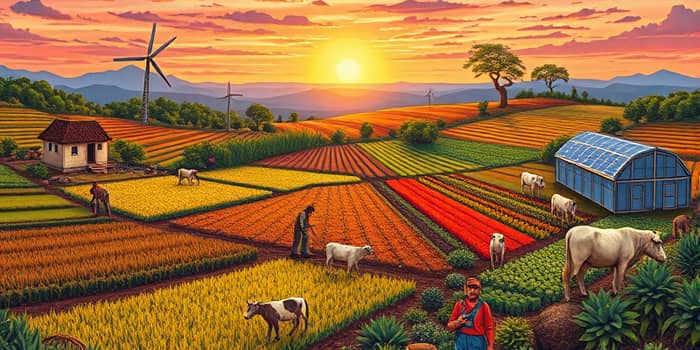
As the global population surges toward 10 billion, the stakes for our planet’s food systems have never been higher. This article explores how we can harness economic insight, technological innovation, and policy action to ensure that every mouth is fed while preserving the Earth’s resources.
Drawing on the latest 2025–2026 data, we highlight the remarkable resilience in production alongside pressing risks. From record wheat and rice stocks to the urgent need for climate-smart agriculture, the path forward is complex but navigable.
Global Food Production and Market Outlook
In 2025, global cereal output reached unprecedented heights, driven by favorable weather in key producing regions and the expansion of precision farming. Wheat inventories rose by 3.6%, while rice stocks climbed 2.2% to record levels. Meat production increased by 1.4%, largely due to booming poultry sectors, even as cattle numbers contracted in Brazil and the United States.
Vegetable oil consumption, however, continues to outpace supply, signaling potential market tightness if planting areas do not recover. Meanwhile, aquaculture growth of 1.7% and per capita consumption gains of 2.5% underscore the rising importance of fish in global diets.
The global food market is valued at an estimated $9.68 trillion in 2026, poised to grow at a 6.17% CAGR through 2030. Compound feed production now exceeds one billion tonnes annually, with a turnover nearing $400 billion, reflecting the integral role of feed in sustaining livestock and aquaculture sectors.
Drivers of Food Insecurity and Hunger
Despite robust outputs, an alarming 20% rise in acute food insecurity since 2020 reveals deep structural challenges. Conflict remains the primary trigger of hunger, affecting hotspots from Afghanistan to Somalia. Climate extremes—droughts, floods, heatwaves—compound these crises, while trade tensions and supply chain disruptions amplify local scarcities.
- Conflict and displacement destroying livelihoods and markets
- Climate-induced shocks undermining crop yields
- Rising input costs eroding farmer profitability
- Deforestation from agriculture degrading entire ecosystems
- Market volatility fueling sudden price spikes
Regions with limited storage and infrastructure face the brunt of this volatility. Low-income and least-developed countries saw their food import bills surge by 8% in 2025, reaching $2.22 trillion, while fertilizer prices, though down 40% from 2022 peaks, still hover around $489 per tonne.
Economic Impacts and Price Dynamics
Global food prices are projected to rise by 2.7% in 2026, with consumer costs for food-at-home up 2.3% and food-away-from-home climbing 3.3%. Wheat and maize saw monthly increases of 1%, rice surged 5%, while wheat futures traded 3% lower year-on-year, reflecting abundant stocks.
This delicate balance has given rise to stagflation risks in several economies: overproduction coexists with flat or declining demand in markets affected by aging populations and shifts toward low-calorie diets. Import-dependent nations face disproportionate burdens, especially as coffee and cocoa prices jump 34.5% for high-income countries and vegetable oil costs spike 58% in least-developed markets.
Trade policies and tariffs, such as levies on olive oil imports, further distort supply chains. Yet the recent drop in Spanish and Greek wholesale prices by 50% since early 2024 offers a glimpse of how policy shifts and bumper harvests can relieve consumer pressure.
Resilience Solutions and Interventions
Building resilient food systems demands a multi-pronged approach: scaling up climate-smart technologies, repurposing subsidies toward sustainability, and strengthening market access for smallholders. The World Bank’s portfolio of projects exemplifies the impact of coordinated action.
Additional interventions span from seed and fertilizer distribution in Guinea Bissau to digital market integration in West Africa, collectively reaching over 327 million people across 90 countries. These initiatives underscore the power of targeted investment and local partnership.
Projections and Policy Shifts Toward 2050
By mid-century, global food demand is forecast to rise by 60%, with animal protein requirements potentially quadrupling based on past trends. Meat demand may grow 70%, aquaculture 90%, and dairy 55%—driving both opportunity and risk.
To navigate this trajectory, policymakers must align incentives with sustainability: reduce deforestation subsidies, bolster cross-border trade, and invest in research from FAO, CGIAR, and national labs. Strengthening data platforms, like the Global Alliance for Food Security dashboard, can improve coordination and early warning for emerging crises.
Investors, governments, and civil society share a common imperative: transform agriculture into a force for regeneration rather than degradation. By embracing innovation and equity, we can secure food for all while protecting our planet.
Feeding the world sustainably is both an economic challenge and a moral mandate. Our collective actions today will determine whether we leave future generations a thriving, resilient food system—or a fractured one. Let us choose ambition, collaboration, and foresight to deliver on this unprecedented task.
References
- https://www.fao.org/newsroom/detail/fao-food-outlook-points-to-broad-based-increase-in-global-food-commodity-production/en
- https://www.worldbank.org/en/topic/agriculture/brief/food-security-update
- https://ifif.org/global-feed/statistics/
- http://www.ers.usda.gov/data-products/food-price-outlook/summary-findings
- https://www.agribusinessglobal.com/markets/global-agriculture-forecast-2026-continued-volatility-and-needed-adaption-ahead/
- https://www.fas.usda.gov/data/world-agricultural-production-02102026
- https://www.fao.org/faostat/
- https://www.statista.com/outlook/cmo/food/worldwide
- https://ourworldindata.org/grapher/value-of-agricultural-production